- Understanding Study Abroad Scholarships: Types and Opportunities for 2026
- Types of Scholarships
- Merit Based:
- Need Based: Targeted at students with financial hardships. The Fund for Education Abroad offers up to $10,000 for minority and first generation students.
- Program Specific: Tied to specific destinations or fields, like the Boren Scholarship for language study in critical regions, awarding up to $25,000.
- Government Funded:
- Types of Scholarships
- Table: Top Study Abroad Scholarships for 2026
- GPA Requirements: Building a Strong Academic Foundation
- Key GPA Insights for 2026
- Extracurricular Activities: Showcasing Your Well Rounded Profile
- Why Extracurriculars Matter
- Table: Extracurriculars and Their Impact on Applications
- Securing Strong Recommendation Letters
- Mastering the Scholarship Interview
- How to Get a Scholarship to Study Abroad, Academic Dreams Into Reality
- Understanding GPA Requirements: How Important Is Your Grade Point Average?
- What GPA Do You Need to Study Abroad?
- How to Improve Your GPA for a Scholarship Application
- Extracurricular Activities: Show Your Well Roundedness
- Why Are Extracurricular Activities Important for Scholarships?
- How to Build Your Extracurricular Profile
- Personal Statement: Crafting a Story That Stands Out
- What Should Your Personal Statement Include?
- Motivation: Why do you want to study abroad, and how will it help you achieve your academic and professional goals?
- Personal Growth: Share how your experiences have shaped who you are today and how studying abroad will help you grow further.
- Academic and Career Goals: Show how your studies abroad align with your long term academic and career aspirations.
- Why You Deserve the Scholarship: Clearly explain why you are the ideal candidate for the scholarship and how you will use the funds to succeed.
- Scholarship Application Tips for Writing a Winning Personal Statement
- Be Authentic: Scholarship committees want to hear your true voice, not a generic response. Be honest about your ambitions and challenges.
- Show Your Passion: Convey your excitement about the opportunity to study abroad and explain how it fits into your academic and professional plans.
- Proofread: A well written personal statement free of grammar and spelling errors makes a positive impression. Ask a mentor, teacher, or friend to read it over before submitting.
- Tailor Your Statement: Customize your personal statement for each scholarship application, aligning your goals with the specific scholarship’s mission or focus.
- Recommendation Letters: Strengthening Your Application with Endorsements
- How to Request a Strong Letter of Recommendation
- Ask Early: Give your recommender plenty of time to write a thoughtful letter. Aim to ask at least 3 4 weeks before the deadline.
- Provide Context: Share the details of the scholarship and your personal statement with the recommender. This will help them tailor the letter to the specific scholarship requirements.
- Highlight Your Achievements: Remind your recommender of specific achievements and moments where you stood out in their class or organization. This makes the letter more personal and powerful.
- What Makes a Strong Recommendation Letter?
- Scholarship Interview Tips: Preparing to Impress
- What to Expect in a Scholarship Interview
- Tips for a Successful Scholarship Interview
- Prepare Ahead: Research common scholarship interview questions and practice your answers. Be ready to discuss your motivations for studying abroad and how the scholarship will impact your future.
- Be Confident: Show enthusiasm about your goals and the scholarship opportunity. Confidence without arrogance can make a lasting impression.
- Dress Professionally: Even if the interview is virtual, dress in a way that conveys professionalism and seriousness about the opportunity.
- Ask Questions: At the end of the interview, asking thoughtful questions about the scholarship program or the university can demonstrate your interest and engagement.
- Conclusion: Turning Your Study Abroad Dreams Into Reality
Meta Description: Discover how to get a scholarship to study abroad in 2026 with expert scholarship application tips for international students, including GPA requirements, extracurricular activities, and a winning scholarship essay guide to make your Study Abroad Scholarships dream a reality.
Studying abroad is more than just an academic adventure it’s a gateway to personal growth, cultural immersion, and career advancement. Imagine strolling through the historic streets of Paris while pursuing a degree in art history, or diving into cutting edge tech research in Tokyo. For many students, however, the dream of international education seems out of reach due to financial barriers. That’s where Study Abroad Scholarships come in. These funding opportunities can cover tuition, living expenses, travel, and more, turning your academic aspirations into tangible experiences.
The importance of securing a Scholarship Application cannot be overstated. According to recent data from the Institute of International Education (IIE), over 1 million U.S. students studied abroad in the 2023 2024 academic year, with scholarships playing a pivotal role in making this possible. For international students, these awards not only alleviate financial strain but also enhance resumes, fostering skills like adaptability and global awareness that employers value. Yet, common misconceptions persist: many believe scholarships are reserved for straight A students or those with elite connections. In reality, while competition is fierce with success rates hovering around 10 20% for popular programs like Fulbright or Gilman strategic preparation can level the playing field. Challenges include navigating complex applications, meeting deadlines, and standing out in a pool of talented applicants. But with the right approach, as outlined in this guide, you can overcome these hurdles.
This comprehensive article will break down the key steps to securing a scholarship for studying abroad in 2026, focusing on GPA requirements, extracurricular activities, personal statement writing, recommendation letters, and interview tips. Whether you’re an international student eyeing U.S. programs or a U.S. resident seeking global opportunities, these scholarship application tips for international students will equip you with actionable insights, supported by statistics, real world examples, and expert advice.

10 Benefits of Studying Abroad | Firsthand Student Experience | PBA • Palm Beach Atlantic University
Alt text: Diverse group of students studying abroad in London, smiling with Big Ben in the background perfect for Study Abroad Scholarships inspiration.
Understanding Study Abroad Scholarships: Types and Opportunities for 2026
Before diving into the application process, it’s essential to grasp what Study Abroad Scholarships entail. These are merit based, need based, or program specific awards designed to support students pursuing education outside their home country. In 2026, opportunities abound, with programs like the Benjamin A. Gilman International Scholarship offering up to $5,000 for U.S. undergraduates of limited financial means, and the Fulbright U.S. Student Program sending graduates abroad for research or teaching.
Types of Scholarships
Merit Based:
Awarded for academic excellence, leadership, or talents. For instance, the CIEE Merit Scholarships provide up to $2,500 based on GPA and program focus.Need Based: Targeted at students with financial hardships. The Fund for Education Abroad offers up to $10,000 for minority and first generation students.
Program Specific: Tied to specific destinations or fields, like the Boren Scholarship for language study in critical regions, awarding up to $25,000.
Government Funded:
Such as the Critical Language Scholarship (CLS), fully funding summer language immersion.
Statistics highlight the demand: The IIE reports a 10% increase in scholarship applications post pandemic, with success rates varying by program Gilman accepts about 25% of applicants, while Fulbright is more competitive at 20%. For 2026, deadlines are approaching: Gilman opens in March, with awards announced by summer.
Real world example: Sarah, a first generation college student from Texas, secured a $5,000 Gilman Scholarship to study in Spain. Her tip? “Research early many programs like CLS have rolling deadlines.”
To find scholarships, use tools like Scholarships.com or Go Overseas, which list over 50 options for 2026. Tailor your search to long tail keywords like “how to get scholarship to study abroad 2026” for targeted results.
Table: Top Study Abroad Scholarships for 2026
Scholarship Name | Amount | Eligibility | Deadline |
Benjamin A. Gilman | Up to $5,000 | U.S. undergrads, Pell Grant recipients | March 5, 2026 |
Fulbright U.S. Student | Varies (full funding) | Recent graduates | October 2025 (for 2026 27) |
Fund for Education Abroad | Up to $10,000 | Minority/first gen students | February 4, 2026 |
Critical Language Scholarship | Full funding | U.S. citizens, language study | November 2025 |
CIEE Scholarships | Up to $2,500 | Merit/need based | April 1, 2026 |
This table illustrates the diversity of options choose based on your profile.
GPA Requirements: Building a Strong Academic Foundation
A solid GPA is often the cornerstone of any Scholarship Application. Most Study Abroad Scholarships require a minimum GPA of 3.0, but competitive ones like Fulbright demand 3.5+. Why? It demonstrates your ability to handle rigorous coursework abroad.
Key GPA Insights for 2026
Minimum Thresholds:
Gilman requires 2.5 3.0, while Boren seeks 3.3+. For international students applying to U.S. programs, a equivalent GPA (e.g., 80% in many systems) is key.Impact on Success:
Data from Scholarships.com shows applicants with 3.5+ GPAs have a 30% higher approval rate.Improving Your GPA:
If yours is below target, focus on upward trends. Take challenging courses and seek tutoring.
Example: John, with a 3.2 GPA, boosted his to 3.6 by excelling in major related classes, securing a $3,000 CIEE grant for Japan.
Tips: Maintain consistency semester GPAs matter. For 2026 applications, aim for a cumulative 3.2+ by fall 2025.
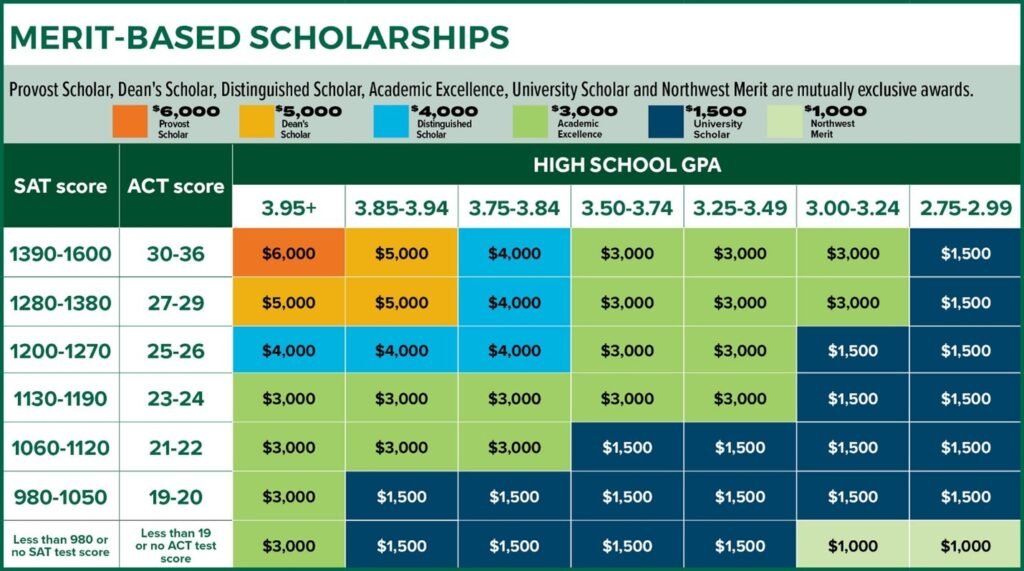
Scholarship Index Chart Northwest Admissions | Northwest
Alt text: GPA and scholarship chart showing award levels based on academic performance essential for how to get scholarship to study abroad 2026.
Extracurricular Activities: Showcasing Your Well Rounded Profile
Extracurriculars are crucial for standing out in Scholarship Applications. They prove you’re more than grades demonstrating leadership, passion, and commitment.
Why Extracurriculars Matter
Stats: 70% of scholarship committees prioritize activities, per a Go Overseas survey. Students with diverse involvement have 25% higher success rates.
Ideal Activities:
Leadership roles (e.g., club president), volunteering, internships, or sports. For study abroad, cultural clubs or language exchanges shine.
Example: Maria led her school’s environmental club, organizing clean ups. This aligned with her application for a sustainability scholarship in Germany, winning $4,000.
Tips for international students: Highlight global experiences, like Model UN. Balance 2 3 deep commitments over superficial ones.
Table: Extracurriculars and Their Impact on Applications
Activity Type | Examples | Scholarship Boost |
Leadership | Student government, club officer | Shows initiative (e.g., Fulbright favors leaders) |
Community Service | Volunteering abroad, local NGOs | Appeals to need based awards like Gilman |
Academic Clubs | Debate, science olympiads | Enhances merit based apps |
Arts/Sports | Theater, athletics | Demonstrates creativity and teamwork |
Incorporate these to strengthen your profile for 2026.
Crafting a Winning Personal Statement or Scholarship Essay
The personal statement is your voice in the Scholarship Application process. It’s where you weave your story, aligning with the “winning scholarship essay guide” principles.
Essential Tips
- Structure: Hook, body (experiences, goals), conclusion. Keep under 1,000 words.
- Content: Be authentic share challenges overcome. For study abroad, explain cultural interest.
- Common Pitfalls: Avoid clichés; use active voice.
Example: “As a first gen immigrant, studying in France will bridge my heritage with global business skills.” This won a $2,500 API scholarship.
Stats: 80% of winning essays show personal growth, per College Essay Guy analysis.
For international students, emphasize adaptation skills. Revise multiple times seek feedback.
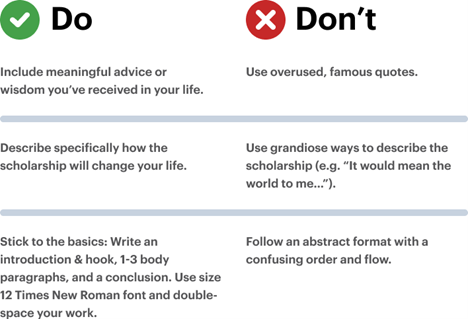
How to Write a Scholarship Essay and Win BIG (2026 Edition) Sallie
Alt text: Scholarship essay writing tips chart with do’s and don’ts your guide to a winning scholarship essay.
Securing Strong Recommendation Letters
Recommendation letters validate your application, providing external perspectives.
How to Get Them
Who to Ask:
Professors, mentors knowing your work ethic.Tips:
Provide context resume, essay draft. Request early.Content: Letters should highlight specifics, like leadership in projects.
Example: A letter praising a student’s research in biology secured a Fulbright spot.
For 2026, aim for 2 3 letters; follow up politely.
Mastering the Scholarship Interview
Interviews are the final hurdle prep to shine.
Common Questions and Tips
Tell us about yourself:
Keep concise, tie to goals.Why this scholarship?
Align with program values.Stats:
60% of interviewees succeed with practice, per Indeed.
Example: Practicing mock interviews helped Alex articulate his passion, winning a $5,000 grant.
Dress professionally, ask questions show enthusiasm.
Conclusion: Next Steps to Secure Your Scholarship
Securing a scholarship to study abroad in 2026 requires strategic preparation across GPA, extracurriculars, essays, letters, and interviews. Remember, persistence pays apply to multiple, like Gilman and CIEE, with deadlines from February to April.
Practical advice: Start now build your profile, research via Go Overseas. Seek mentorship; track applications. With these scholarship application tips for international students, your dream is achievable. Share your journey in comments or on social media let’s inspire others!
How to Get a Scholarship to Study Abroad, Academic Dreams Into Reality
Studying abroad is an opportunity that can shape your academic and professional future in ways unimaginable. From experiencing new cultures to gaining an edge in the global job market, studying abroad opens doors to opportunities that can significantly enhance your educational journey. However, one of the biggest challenges for many students aspiring to study internationally is securing a scholarship to fund their studies. Scholarships offer financial relief and make studying abroad a reality for countless students.
In this guide, we’ll walk you through the key steps and strategies you can employ to maximize your chances of receiving a study abroad scholarship. From understanding GPA requirements to writing a standout personal statement, we’ll cover everything you need to know to successfully navigate the scholarship application process.
Understanding GPA Requirements: How Important Is Your Grade Point Average?
Your Grade Point Average (GPA) is often one of the first factors that scholarship providers will evaluate when considering your application. A high GPA can significantly boost your chances of being awarded a scholarship, especially for merit based scholarships. Generally, scholarship programs for studying abroad are competitive, and providers want to ensure that the recipients of their awards are academically capable.
What GPA Do You Need to Study Abroad?
Different scholarships have varying GPA requirements depending on the institution and the level of the scholarship. In many cases, a GPA of 3.0 or above is considered competitive for undergraduate and graduate scholarships. However, more prestigious scholarships, such as those from government organizations or top universities, may require a GPA of 3.5 or higher.
It’s essential to research the specific GPA requirements for the scholarships you’re interested in. Some scholarships, especially for international students, may also consider other factors like standardized test scores (e.g., GRE, SAT), but your GPA will likely remain one of the most critical components of your application.
How to Improve Your GPA for a Scholarship Application
If your GPA is not yet where you’d like it to be, there are ways to improve it before you apply for scholarships. Focus on excelling in your coursework, seeking help from professors or tutors when needed, and participating actively in class discussions. Additionally, prioritizing your academic responsibilities, especially in your final semesters before applying for scholarships, can show commitment to your studies.
Extracurricular Activities: Show Your Well Roundedness
Scholarships are not only awarded based on academic achievement; many providers also look for well rounded students who contribute to their communities through extracurricular activities. Being involved in clubs, sports, volunteer work, or internships can strengthen your scholarship application by showcasing your leadership skills, teamwork, and commitment outside the classroom.
Why Are Extracurricular Activities Important for Scholarships?
Extracurricular activities demonstrate your ability to balance academics with other interests, showing that you’re a well rounded individual. Many scholarship committees value this because it suggests that you will be able to contribute to the university community in a meaningful way. Additionally, it highlights your time management skills, leadership potential, and social responsibility.
For study abroad scholarships, involvement in international exchange programs, language clubs, or cultural organizations can also make you stand out. These activities show that you are already engaged in global issues and have a genuine interest in studying abroad.
How to Build Your Extracurricular Profile
If you don’t have much extracurricular involvement yet, start by looking for opportunities that align with your interests. Volunteer for causes you care about, join clubs at your university, and seek internships related to your field of study. It’s important to be passionate about these activities, as genuine commitment shines through in your application essays and interviews.
Personal Statement: Crafting a Story That Stands Out
One of the most crucial aspects of a scholarship application is the personal statement. This essay allows you to tell your story and explain why you deserve the scholarship. A well written personal statement can be the difference between securing the scholarship and being passed over.
What Should Your Personal Statement Include?
Your personal statement should be clear, concise, and engaging. Focus on these key points:
Motivation: Why do you want to study abroad, and how will it help you achieve your academic and professional goals?
Personal Growth: Share how your experiences have shaped who you are today and how studying abroad will help you grow further.
Academic and Career Goals: Show how your studies abroad align with your long term academic and career aspirations.
Why You Deserve the Scholarship: Clearly explain why you are the ideal candidate for the scholarship and how you will use the funds to succeed.
Scholarship Application Tips for Writing a Winning Personal Statement
When writing your personal statement for study abroad scholarships, remember to:
Be Authentic: Scholarship committees want to hear your true voice, not a generic response. Be honest about your ambitions and challenges.
Show Your Passion: Convey your excitement about the opportunity to study abroad and explain how it fits into your academic and professional plans.
Proofread: A well written personal statement free of grammar and spelling errors makes a positive impression. Ask a mentor, teacher, or friend to read it over before submitting.
Tailor Your Statement: Customize your personal statement for each scholarship application, aligning your goals with the specific scholarship’s mission or focus.
Recommendation Letters: Strengthening Your Application with Endorsements
Letters of recommendation are another essential component of the scholarship application process. These letters provide scholarship committees with insight into your character, work ethic, and achievements from someone who knows you well, such as a professor, employer, or mentor.
How to Request a Strong Letter of Recommendation
When requesting a recommendation letter, be strategic about who you ask. Choose individuals who know you well and can speak to your strengths in both academic and extracurricular contexts. Here are some tips to ensure you get a compelling letter:
Ask Early: Give your recommender plenty of time to write a thoughtful letter. Aim to ask at least 3 4 weeks before the deadline.
Provide Context: Share the details of the scholarship and your personal statement with the recommender. This will help them tailor the letter to the specific scholarship requirements.
Highlight Your Achievements: Remind your recommender of specific achievements and moments where you stood out in their class or organization. This makes the letter more personal and powerful.
What Makes a Strong Recommendation Letter?
A strong recommendation letter should:
- Be specific, detailing your accomplishments and strengths
- Highlight your academic ability, character, and potential for success
- Demonstrate how you’ll contribute to the university community or the scholarship program
- Provide concrete examples of your achievements and skills
Scholarship Interview Tips: Preparing to Impress
If you’re selected for an interview as part of the scholarship application process, congratulations! The interview is your opportunity to further showcase your passion, goals, and qualifications. Here’s how you can prepare:
What to Expect in a Scholarship Interview
The scholarship interview is typically an opportunity for the selection committee to learn more about you beyond your application materials. Expect to be asked questions about your academic interests, reasons for wanting to study abroad, your extracurricular activities, and your long term career plans.
Tips for a Successful Scholarship Interview
Prepare Ahead: Research common scholarship interview questions and practice your answers. Be ready to discuss your motivations for studying abroad and how the scholarship will impact your future.
Be Confident: Show enthusiasm about your goals and the scholarship opportunity. Confidence without arrogance can make a lasting impression.
Dress Professionally: Even if the interview is virtual, dress in a way that conveys professionalism and seriousness about the opportunity.
Ask Questions: At the end of the interview, asking thoughtful questions about the scholarship program or the university can demonstrate your interest and engagement.
Conclusion: Turning Your Study Abroad Dreams Into Reality
Securing a scholarship to study abroad may seem like a daunting process, but with the right preparation and strategy, you can increase your chances of success. Focus on maintaining a competitive GPA, getting involved in extracurricular activities, writing a compelling personal statement, securing strong recommendation letters, and preparing for scholarship interviews. By staying organized and dedicated, you’ll be one step closer to turning your academic dreams into reality.
As you embark on this journey, remember that persistence pays off, and every application is an opportunity to learn and grow. The scholarships available to students can provide the financial support you need to access a world class education and make a lasting impact on your academic and professional career.